Beyond the Search Bar: 5 Surprising Realities of Ranking in Google’s AI Mode
Published on 01/29/2026 | By Silent Freeway
Beyond the Search Bar: 5 Surprising Realities of Ranking in Google’s AI Mode
TL:DR
Google AI Mode ranks entities, not pages. Brands win by covering intent clusters, earning real mentions, and appearing across video, community, and authoritative platforms.
Introduction: The Familiarity Pivot
As of September 2025, the digital landscape is defined by a critical shift in how people search. Google still processes orders of magnitude more searches than AI-first tools, but the behavior inside Google has changed. Users are no longer scanning lists of links — they are asking questions and expecting conclusions.
Google’s AI Mode turns the traditional SERP into a synthetic research environment. One click on “Dive deeper in AI Mode” moves the user from search results into an AI-led dialogue powered by Gemini.
This changes the objective.
We are no longer optimizing pages to rank.
We are building brand entities the AI can confidently recommend.
Takeaway 1: Query Fan-Out — One Question, Many Searches
What changed
In Google’s AI Mode, a single question no longer maps to a single search.
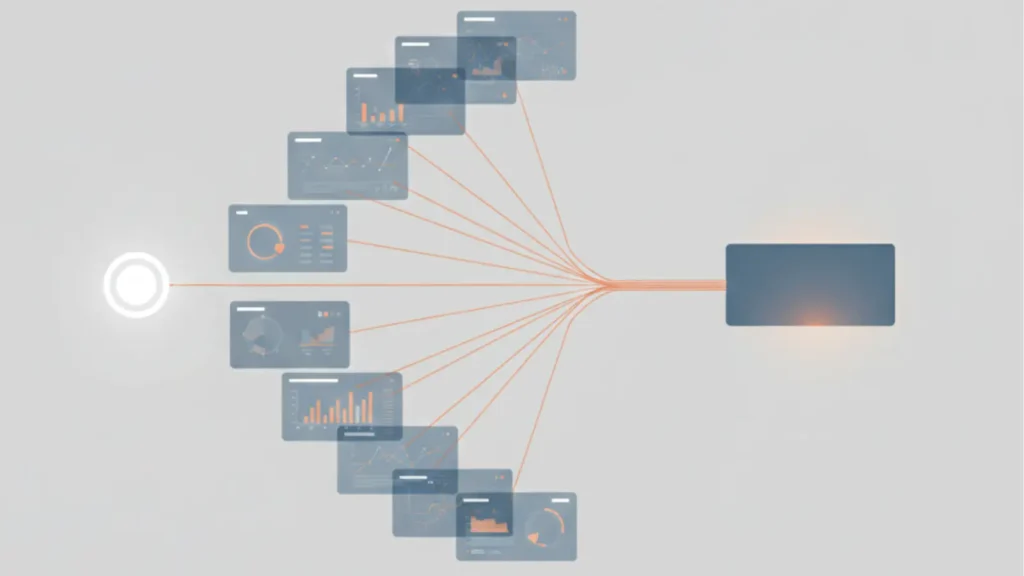
Gemini automatically triggers 5–20 background searches to understand comparisons, alternatives, technical details, and edge cases before generating an answer.
A user asks “best WordPress SEO plugin”. Gemini fans out into:
- Rank Math vs Yoast
- SEO Press vs Rank Math
- Best schema plugin
- WordPress site speed impact
- Migration difficulty
The user never sees these searches — but your content is evaluated against all of them.
What to do now
Stop optimizing for one keyword per page.
Instead, structure content to cover the full intent cluster the AI will explore.
That means:
- Address comparisons and alternatives
- Explain differentiators clearly
- Answer related “how,” “vs,” and “best for” questions
- Consolidate related answers into one authoritative resource
If your page doesn’t answer the questions Gemini is silently asking, it won’t be recommended.
Takeaway 2: Deep Research — What Gemini Actually Evaluates
What changed
In Google’s AI Mode, ranking is no longer based on surface-level keyword matching.
Gemini uses a deep research layer that runs a hidden comparative query fan-out before generating an answer.
Instead of evaluating one page, the AI researches:
- Multiple competing solutions
- Feature and capability differences
- Performance and technical impact
- Cost, friction, and ease of migration
This research happens before any response is generated.
What Gemini actually looks for
From observed Deep Research behavior, Gemini prioritizes:
- Authoritative comparison reviews
- Clear, repeatable differentiators
- Technical proof points (schema quality, site speed impact)
- Evidence that switching or adoption is easy
The AI then synthesizes these findings across sources to form a brand-level perception.
This is Entity SEO in practice.
Example of how that perception forms:
“Certain tools are repeatedly cited as offering stronger built-in schema capabilities with minimal performance impact.”
What to do now
Your goal is no longer ranking a page.
Your goal is owning a position in the AI’s internal comparison model.
That means:
- Publishing comparison-ready content
- Making differentiators explicit, not implied
- Supporting claims with technical specifics
- Addressing migration and usability head-on
If your content avoids comparison or specificity, Gemini will prefer brands that don’t.
Your goal is not ranking a page.
Your goal is owning a position in the AI’s mental model.
Takeaway 3: Branded Mentions Beat Backlinks
What changed
In Google’s AI Mode, authority is no longer inferred primarily from backlinks.
Gemini evaluates how often and how consistently a brand is mentioned across trusted, independent sources.
The AI scans for:
- Brand mentions in context
- Repeated references across platforms
- Signals that real people discuss and recommend a solution
This includes mentions with or without links.
Backlinks still matter, but they are no longer the strongest signal for AI recommendation.
What to do now
Stop relying solely on link acquisition as a growth strategy.
Start building visible brand authority across the web.
That means:
- Earning mentions in industry publications and communities
- Being discussed in forums, podcasts, and social platforms
- Contributing expert commentary and original insights
- Avoiding paid placements that generate no real engagement
If people aren’t talking about your brand in public, the AI has nothing to trust.
Your goal is not collecting links.
Your goal is earning consistent, independent brand validation.
Takeaway 4: The 65% Video Advantage
What changed
In Google’s AI Mode, experience signals matter more than text alone.
Observed AI Overview behavior shows that video sources—especially YouTube—are cited the majority of the time when the AI explains or recommends solutions.
This happens because video provides:
- A visible human expert
- Demonstrated problem-solving
- Context that text alone often lacks
For AI systems, seeing and hearing a solution reduces uncertainty.
What to do now
Stop treating video as optional or “nice to have.”
Start using it as proof of expertise.
That means:
- Publishing explainer or comparison videos
- Showing real workflows, not marketing demos
- Appearing on podcasts or recorded interviews
- Being present on platforms where people learn, not just read
Text explains.
Video confirms.
If your brand only exists as written content, the AI has fewer signals to trust.
Your goal is not just being readable.
Your goal is being recognizable as an expert.
Takeaway 5: The Three-Phase Growth Framework
What changed
Winning in Google’s AI Mode is not a single tactic.
It requires intentional brand positioning, followed by consistent reinforcement across the web.
AI systems don’t “discover” brands randomly.
They recognize brands that show up repeatedly, clearly, and consistently around a defined position.
This makes AI visibility a phased process, not a one-off optimization.
What to do now
Approach AI visibility as an architectural build, not a campaign.
Phase 1: Foundation — The Position
Decide what you want the AI to know you for.
- Lowest cost
- Highest quality
- Best for non-technical users
- Enterprise-ready
- Topical authority
Then support that position with:
- Helpful, problem-solving content
- Clear brand and founder information
- Press- and citation-ready assets
Phase 2: Outreach — The Push
Actively place your expertise where the AI looks for authority.
- Industry publications
- News and commentary
- Case studies and proprietary insights
Don’t ask for links.
Offer information worth citing.
Phase 3: Amplification — The Pull
Create ongoing visibility that signals market leadership.
- Podcasts and interviews
- Creator and affiliate ecosystems
- Consistent community engagement
This creates the “consistent stir” AI systems interpret as authority.
This generates repeat brand mentions, the strongest AI trust signal.
Strategic shift
AI visibility is not about volume.
It’s about positioning reinforced over time.
Your goal is not short-term traffic.
Your goal is becoming the brand the AI expects to recommend.
The shift from SEO to GEO isn’t theoretical.
It shows up clearly in how content is structured, evaluated, and surfaced in AI-driven search.
SEO vs GEO: How Optimization Has Changed
| Aspect | SEO | GEO |
|---|---|---|
| Primary Goal | Rank on Google SERPs | Be cited in AI responses |
| Visibility Outcome | Blue links + snippets | AI Overviews, AI Mode summaries |
| Content Structure | Long-form narrative | Modular, scannable blocks |
| Typical Length | 800–1,500+ words | Flexible (400–1,200 words) |
| Optimization Focus | Keywords + on-page signals | Entities, intent clusters |
| Keyword Strategy | 1 primary + related terms | Query fan-out coverage |
| Use of Citations | Helpful but optional | Strongly favored for trust |
| Paragraph Length | 4–6 sentences | 2–4 sentences |
| Preferred Format | Human readability | AI extractability + clarity |
AI Summary (Designed for AI Overviews)
Google AI Mode ranks entities, not pages. Brands win visibility by covering full intent clusters, earning real-world mentions, and appearing across video, community, and authoritative platforms.
SEO Agency vs GEO Strategy (SMB Reality Check)
| Question SMBs Ask | Traditional SEO Agency | GEO-Focused Strategy |
|---|---|---|
| “Will I rank?” | Targets keywords | Targets AI recommendations |
| “Where will I show up?” | Search results | AI answers + summaries |
| “How long does it last?” | Fragile to updates | Compounds with brand trust |
| “What scales?” | More pages | More mentions + clarity |
| “What’s the risk?” | Algorithm shifts | Brand credibility |
How this plays out for SMBs
The shift from SEO to GEO changes what small and mid-sized businesses should prioritize.
Visibility is no longer about publishing more content or acquiring more links — it’s about clarity, positioning, and consistent brand presence across the web.
Conclusion: The Sustainability Test
The shift to Google’s AI Mode is not about gaming systems.
It’s about earning recommendation-level trust.
AI systems don’t reward tactics — they reward reputation.
They look for brands that are consistently mentioned, clearly positioned, and validated by real people across the web.
The real test is simple:
If your brand isn’t being recommended in real communities, how long can traffic-based optimization keep working?
In the AI era, visibility follows credibility.
Everything else is temporary.
FAQs about AI Overviews
 Call us at 1-888-SEO-PPC1 or email us to schedule your free consultation.